Fair Play in Youth Football Starts Before Kick-off
Fair play in youth football is easier to practise when clubs agree on touchline conduct, injury stoppages and post-match concerns before tension rises.
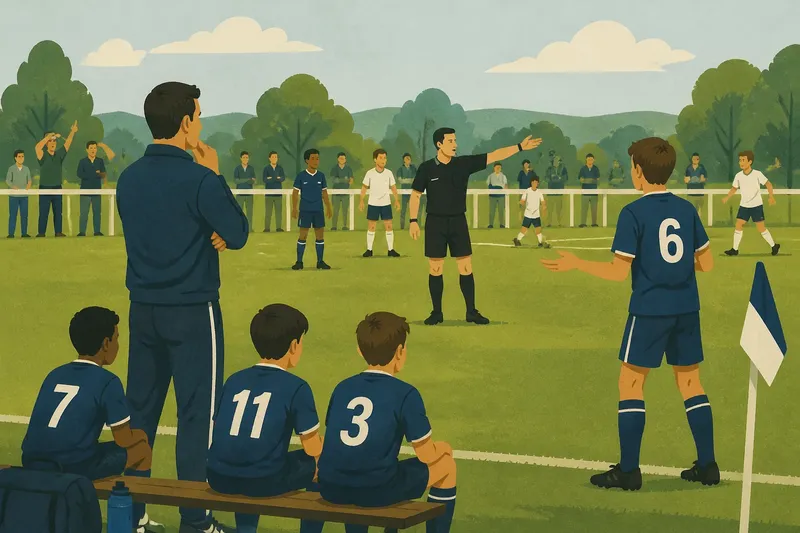
At a youth football match, a parent calls for a foul while the referee waves play on. A player turns towards the touchline, and the coach has to decide whether to intervene. Fair play in youth football is shaped not only by the call, but by the habits a club has prepared for moments like this.
Good match governance gives children and adults clear roles. The referee makes decisions on the pitch. Coaches guide their teams. Parents support without directing play. When clubs explain those boundaries before a fixture, a disputed call is less likely to become a public argument.
Give everyone a clear role on match day
A youth fixture brings together people with different responsibilities. Confusion grows when a parent tries to referee from the sideline, a coach debates every decision, or a player feels obliged to defend an official from adults.
Before kick-off, the coach can tell players to leave questions to the captain and explain that adults should speak to the referee only through the agreed club or competition process. Parents can be asked to encourage effort rather than call for fouls or criticise young players.
These boundaries are not a ban on raising concerns. They keep the immediate match manageable and give a concern a suitable route. If someone is unsure which route applies, the club secretary or competition organiser can clarify it.
Agree practical expectations before the teams meet
Some match-day tensions concern customs rather than the written laws of the game. Teams may have different expectations about returning the ball after an injury stoppage, how much space to give a goalkeeper, or who speaks to the referee.
A brief pre-match conversation can make those expectations visible without inventing new rules. Coaches can check the competition’s guidance, tell captains what practice will be followed and ask the referee to clarify anything that affects their authority.
- If the competition has a stated procedure for injury stoppages, tell both captains what it is; if it has none, ask the referee how play will restart rather than assuming a custom is binding.
- If parents are unsure where to stand, check the venue or competition instructions; if no boundary is marked, ask the organiser where spectators should gather.
- If a player is uncertain who may approach the referee, explain the team’s captain-led practice; if the competition requires another route, follow that instruction instead.
- If a coach spots a possible clash between a club custom and competition rules, check with the organiser before kick-off; if they conflict, follow the competition’s rules.
- If a player is upset before play resumes, ask the captain to listen briefly; if the player cannot settle, involve the coach and follow the club’s welfare procedure.
- If adults begin calling instructions from the touchline, remind them of the agreed conduct; if the behaviour continues, ask the club’s designated contact to address it after the match.
Each item gives people a next action and an alternative when the first route does not fit. The point is not to script every conversation. It is to prevent children from having to invent a response while adults argue around them.
Keep a concern separate from the live match
A question about a decision can be brief and respectful. A captain might ask what the referee saw, then relay the answer to teammates. Repeating the same protest, surrounding the official or directing anger at an opponent is unlikely to settle the issue.
Say you are coaching an invented under-14 side called Northfield. Before a fixture, you learn that the home team expects the captain to raise questions, while your players usually speak for themselves. You check the competition guidance, which says the referee controls communication on the pitch but does not set a captain-only rule. You tell your players that the captain will ask a concise question if needed, while any formal complaint goes through the club secretary after the match. During play, a player asks whether a challenge was judged as fair contact; the captain asks once, hears the referee’s answer and leads the team back into position. The immediate result is a clear route for the question without turning the touchline into a hearing. The trade-off is that the player may still disagree, and a formal concern must wait until the match is over.
If a concern remains, the club can record what happened in plain terms and use the competition’s stated process. A useful account identifies the match, the moment in question and the outcome being sought, such as clarification of a rule. It avoids turning an uncertain judgement into a claim about someone’s character.
How should clubs handle common match-day questions?
Can a parent challenge a decision during play?
Parents should follow the competition’s touchline conduct rules and avoid confronting young players or officials. If a concern needs attention, they can ask the club’s designated contact about the appropriate process after the match.
Who should speak to the referee for a youth team?
That depends on competition rules and the referee’s instructions. Where no specific procedure applies, a captain-led question can reduce several players speaking at once, but it does not replace any formal reporting route.
What should a coach do when a player is distressed?
Move the discussion away from the immediate crowd and listen calmly, following the club’s welfare arrangements. If there is an urgent safety or safeguarding concern, contact the appropriate responsible person or qualified professional rather than trying to settle it through a sideline argument.
How can a club raise a concern about officiating?
Check the league or competition process and submit the concern through the named club contact. Keep the account specific and factual, and ask for clarification or review rather than making unsupported accusations.
Review the club’s approach after the whistle
A short debrief can reveal whether the club’s arrangements were clear. Coaches can ask captains whether they knew how to raise a question, check whether parents understood the touchline expectations and note any point that needs clarification from the competition.
For example, if two parents independently ask where they should stand, the club can update its pre-match message or request clearer venue guidance. If players are unsure who may speak to the referee, the coach can explain the procedure at training and check that it matches competition rules.
Fair play in youth football becomes easier to recognise when responsibilities are clear before tension rises. A useful next step for a club is to put its match-day expectations in a short message that names who handles questions, where parents should stand and how concerns are raised after the final whistle.