How to Assess a Clean Sport Integrity Programme Claim
Assess a clean sport integrity programme claim by checking its scope, procedures and public evidence, so you can distinguish an operating process from promotion.
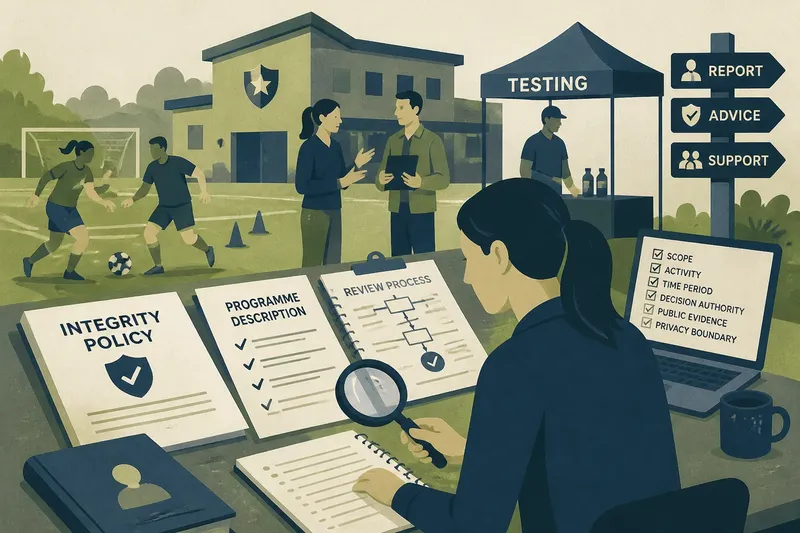
What does a clean sport integrity programme claim actually tell you? A clean sport integrity programme claim may describe education, reporting routes or anti-doping procedures, but those are different activities with different evidence behind them. The useful question is not whether the message sounds convincing; it is what specific part of the programme the organisation can document.
Integrity programmes are often described in broad language, while their components have narrower purposes. An education session can explain rules. A reporting route can give people somewhere to raise concerns. A written procedure can set out how an organisation says it will respond. None of those, by itself, establishes that every relevant person took part or that a particular case was handled correctly.
Separate programme activities from programme outcomes
Start by identifying the activity named in the claim. “We provide anti-doping education” is a claim about an activity. “Our programme prevents violations” is a claim about an outcome. The second requires a much clearer account of how the organisation knows that result follows from its programme.
Look for distinctions between what is planned, what has been delivered and what has been reviewed. A policy describes intended practice. A session schedule describes planned activity. Attendance records, suitably protected, may support a claim that a session took place for a defined group. A review process may explain how the organisation checks whether its arrangements are being applied. Each item supports a different statement; avoid treating them as interchangeable.
Imagine a fictional regional club posts, “Our integrity programme protects fair competition,” and links to a policy but no description of delivery or review. The starting information is the public statement and the policy. You read the policy, note that it sets out responsibilities but says nothing about recent sessions or oversight, then ask the club for a public description of those processes. If it provides one, you can report that the club describes those activities; if it cannot, the outcome claim remains unsupported by the material available, rather than disproved.
Check whether the claim has a defined scope
A programme claim should make clear who and what it covers. It might apply to a team, a whole club, a competition, or a particular group of staff. It may cover education and reporting but not testing or case decisions. If the wording does not specify the boundary, ask before drawing a broad conclusion.
- Named group: Check whether the claim identifies athletes, coaches, medical staff or everyone in the organisation. If it names a limited group, describe it that way; if it says “everyone” without support, ask for the basis or use narrower wording.
- Named activity: Check whether the material describes education, testing, advice or case handling. If it identifies one activity, attribute only that activity; if it bundles several together, ask which procedures support each one.
- Time period: Check whether the claim says when the programme operated or was reviewed. If it gives a period, keep your description within it; if it does not, ask for a current account before presenting it as ongoing.
- Decision authority: Check who is responsible for receiving concerns and deciding what happens next. If a role or body is named, refer to that route; if responsibility is unclear, ask the organisation to identify the appropriate contact.
- Public evidence: Check whether a policy or process description is accessible. If it is linked and matches the claim, cite what it says; if only a slogan is available, describe the message as a claim and seek supporting material.
- Privacy boundary: Check whether the organisation explains what it can disclose about individual cases. If it provides a reasoned limit, report that limit without guessing; if the boundary is unclear and a specific case matters, seek guidance from a qualified communications or legal professional.
Read documents for what they establish
A policy is useful because it gives readers a standard to compare with an organisation’s public description. It does not establish that staff followed the policy in a particular matter. For that, the organisation would need to explain the relevant process and, where appropriate, provide information about its application without exposing confidential details.
Look for practical features: who owns the policy, who receives reports, how concerns are referred, and where a person can find current guidance. If a document names a contact route, check that the linked address or form is available. If it refers to an external sporting body, identify which responsibilities sit with that body rather than assuming the club controls every decision.
Images and campaign posts need the same care. A photograph of an education session shows a session in progress, not who else received the material. A testing station in an event image shows a visible facility, not the design or reach of a testing programme. Describe the item shown, then keep any wider claim tied to separate supporting information.
Which evidence supports which claim?
Does an education record show that a programme worked?
It may support a limited claim that education was delivered to the people covered by the record. It does not, on its own, show that participants understood the material or that the programme prevented misconduct.
Can a policy confirm that a concern was handled properly?
A policy explains the intended process, not how a particular concern was treated. A responsible public account can describe the route and relevant oversight while protecting private information.
What does a public report add?
A report can clarify activities, responsibilities and review arrangements if it says what the organisation actually covers. Check its date, scope and limitations before applying it to a separate team or case.
How should a journalist describe missing information?
State what material was available and what it did not address. Do not turn a gap into an accusation; if the organisation does not answer, attribute that fact clearly and leave the unanswered point open.
Write the claim at the level the evidence supports
For a reporter, club member or athlete asked to share a campaign, precise wording is more useful than a sweeping endorsement. “The club publishes an anti-doping policy” is narrower than “the club’s programme ensures clean competition”. If you cannot verify a claim about delivery, oversight or outcomes, ask for a version that describes the commitment or process actually documented.
For instance, say you are a volunteer preparing a club newsletter. The starting material is a campaign graphic and a current policy naming a reporting contact, but no information about education sessions. You check that the policy link works, write that the club publishes a policy and names a contact for concerns, then leave out any claim that all members received training. The resulting description is specific and attributable; the trade-off is that it makes a smaller claim than the campaign graphic might suggest.
When you assess a clean sport integrity programme claim, keep the scope, activity and supporting material together. A clearly described process can help people understand where responsibility sits and what to ask next. If the evidence stops at a promise, say so plainly; if private details are involved, respect the relevant rules and seek qualified advice where disclosure obligations are uncertain.